
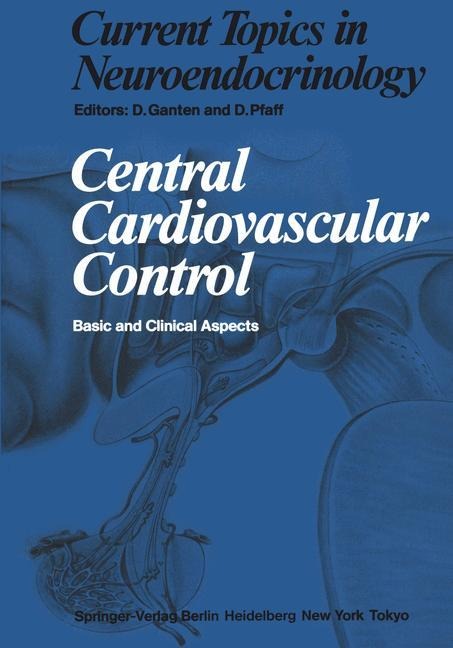
Central Cardiovascular Control: Basic and Clinical Aspects -
-40% koodiga BOOKS
Saadetis 12-18 tööpäeva jooksul
30-päevane tagastamisõigus
The most prominent function of the central nervous system is the control of motor functions by rapidly transmitted impulses through efferent cranial and spinal peripheral nerves. Besides electrically transmitted neural impulses, humoral mechanisms with more sustained actions are exercised by the brain and spinal cord to regulate body homeostasis. Thus, the brain may be regarded as an "endocrine gland" disch ... Täielik kirjeldus
Võib-olla meeldib sulle ka
 TOP
TOP

Determined: The Science of Life Without Free Will
-40% koodiga BOOKS
Meie tarnija laos
TOP

The Light Eaters: How the Unseen World of Plant Intelligence Offers a New Understanding of Life on Earth
-40% koodiga BOOKS
Meie tarnija laos
 TOP
TOP

Why We Sleep: Unlocking the Power of Sleep and Dreams
-40% koodiga BOOKS
Laos
TOP

The Rise and Fall of the Dinosaurs: A New History of a Lost World
-40% koodiga BOOKS
Meie tarnija laos
TOP
Biology: A Global Approach, Global Edition
Neil Campbell, Rebecca Orr, Lisa Urry, Peter Minorsky, Michael Cain, Jane Reece, Steven Wasserman
-40% koodiga BOOKS
Meie tarnija laos
TOP

Six Not-so-easy Pieces: Einstein's Relativity, Symmetry, and Space-Time
Richard P. Feynman, Robert B. Leighton, Matthew Sands
-40% koodiga BOOKS
Meie tarnija laos
TOP

Explaining AuDHD: The expert-led guide to Autism and ADHD Co-concurrence
-40% koodiga BOOKS
Meie tarnija laos
TOP


The Age of Alchemy: How Early Innovators Shaped Modern Chemistry
-40% koodiga BOOKS
Meie tarnija laos
TOP

Factfulness: Ten Reasons We're Wrong About the World--and Why Things Are Better Than You Think
Ola Rosling, Anna Rosling Rönnlund, Hans Rosling
-40% koodiga BOOKS
Meie tarnija laos
TOP
Why Machines Learn: The Elegant Maths Behind Modern AI
-40% koodiga BOOKS
Meie tarnija laos
 TOP
TOP

Entangled Life: How Fungi Make Our Worlds, Change Our Minds and Shape Our Futures
-40% koodiga BOOKS
Meie tarnija laos
TOP

Life As No One Knows It: The Physics of Life's Emergence
-40% koodiga BOOKS
Meie tarnija laos
TOP

The Rise and Reign of the Mammals: A New History, from the Shadow of the Dinosaurs to Us
-40% koodiga BOOKS
Meie tarnija laos
TOP

Molecular Biology of the Cell
David Morgan, Alexander Johnson, Rebecca Heald, Bruce Alberts, Martin Raff
-40% koodiga BOOKS
Meie tarnija laos
TOP
Learn Faster, Perform Better: A Musician's Guide to the Neuroscience of Practicing
-40% koodiga BOOKS
Meie tarnija laos
TOP

Janeway's Immunobiology
Leslie J. Berg, Kenneth Murphy, Casey Weaver
-40% koodiga BOOKS
Meie tarnija laos
TOP

The Road to Reality: A Complete Guide to the Laws of the Universe
-40% koodiga BOOKS
Meie tarnija laos
TOP
The Brain That Changes Itself: Stories of Personal Triumph from the Frontiers of Brain Science
-40% koodiga BOOKS
Meie tarnija laos
Kirjeldus
The most prominent function of the central nervous system is the control of motor functions by rapidly transmitted impulses through efferent cranial and spinal peripheral nerves. Besides electrically transmitted neural impulses, humoral mechanisms with more sustained actions are exercised by the brain and spinal cord to regulate body homeostasis. Thus, the brain may be regarded as an "endocrine gland" discharging neurohormones (peptides) either into the general circulation (neurohypophyseal hormones) or into the hypothalamo-adenohypophyseal portal circulation (releasing and inhibiting hormones). The brain, therefore, which is protected by the blood-brain barrier from disturbing and potentially noxious exogenous and endogenous agents circulating in the blood, has to have certain neurohemal regions beyond this barrier, such as the neural lobe and the median eminence (infundibulum), where neurohor mones have free access to the blood stream. To regulate somatic and autonomic functions in the best possible way, the central nervous system is highly dependent on feedback signals conveyed through somatic and visceral afferent nerves as well as on peripheral humoral signals such as peripheral hormones and other circulating substances that are under homeostatic regulation, e. g. , peptides, arnines, electrolytes, and other biologically active agents. In this chapter, the role of the blood-brain barrier in the regulation of these sub stances will be discussed with special emphasis on the access through the blood-brain barrier to cardiovascular centers. 2 The Blood-Brain Barrier 2.
Lisateave
| Kirjastaja | Springer Berlin Heidelberg |
|---|---|
| Series | Current Topics in Neuroendocrinology |
| Väljalaskeaasta | 2011 |
| Kaanetüüp | Pehme kaanega |
| EAN | 9783642684920 |