
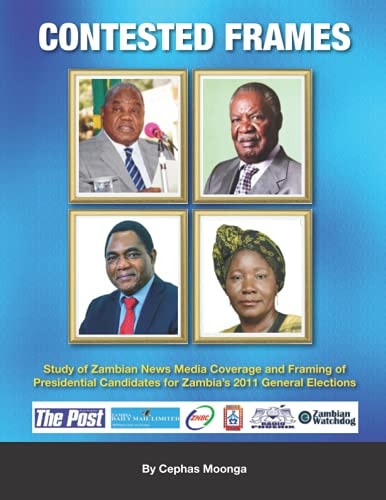
Contested Frames - Cephas Moonga
-25% koodiga BOOKS
Saadetis 10-16 tööpäeva jooksul
30-päevane tagastamisõigus
FOREWORD In many ways, media coverage of electoral candidates in Zambia has generally tended towards a predictability that speaks to the bias that lies in the structure of media ownership. It is thus not surprising for any objective research to establish that government-owned and run media generally tend to portray incumbent politicians in a positive light, while privately owned and run media often do the o ... Täielik kirjeldus
Võib-olla meeldib sulle ka
 TOP
TOP

Atomic Habits: An Easy & Proven Way to Build Good Habits & Break Bad Ones
-25% koodiga BOOKS
Laos
TOP

The Culture Map: Breaking Through the Invisible Boundaries of Global Business
-25% koodiga BOOKS
Laos
 TOP
TOP
Prisoners of Geography: Updated 10th Anniversary Edition: Ten Maps That Tell You Everything You Need To Know About Global Politics
-25% koodiga BOOKS
Meie tarnija laos
 TOP
TOP

Everything I Know About Love: Now a Major BBC One Series
-25% koodiga BOOKS
Laos
TOP

Women Who Run with the Wolves: Myths and Stories of the Wild Woman Archetype
Clarissa Pinkola Estés, Clarissa Pinkola Estes
-25% koodiga BOOKS
Meie tarnija laos
TOP
How Democracies Die
Steven Levitsky, Daniel Ziblatt
-25% koodiga BOOKS
Meie tarnija laos
 TOP
TOP


Classic Football Shirts
Classic Football Shirts, Rory Smith
-25% koodiga BOOKS
Meie tarnija laos
 TOP
TOP

Braiding Sweetgrass: Indigenous Wisdom, Scientific Knowledge and the Teachings of Plants
-25% koodiga BOOKS
Meie tarnija laos


 TOP
TOP
Surrounded by Idiots: The Four Types of Human Behavior and How to Effectively Communicate with Each in Business (and in Life)
-25% koodiga BOOKS
Meie tarnija laos
TOP
The Testaments: The Sequel to The Handmaid's Tale
-25% koodiga BOOKS
Meie tarnija laos
TOP
World Travel: An Irreverent Guide
Anthony Bourdain, Laurie Woolever
-25% koodiga BOOKS
Meie tarnija laos
Kirjeldus
FOREWORD
In many ways, media coverage of electoral candidates in Zambia has generally tended towards a predictability that speaks to the bias that lies in the structure of media ownership. It is thus not surprising for any objective research to establish that government-owned and run media generally tend to portray incumbent politicians in a positive light, while privately owned and run media often do the opposite. Several research outputs, including those of my own, have demonstrated this binarism in media coverage.
Contested Frames: A Study of Zambian News Media Coverage and Framing of Presidential Candidates for Zambia's 2011 General Elections by Cephas Moonga joins such a list of research projects, but with an arguably fresher theoretical approach towards understanding how the media reported on the presidential candidates during the 2011 general elections.
Although Mr. Moonga analyzes this media coverage in terms of 'framing' as a theoretical framework, he goes to great lengths to discuss a multiplicity of other theoretical antecedents that lead up to framing as an analytical tool not only for sorting out the murkiness of journalistic reporting on presidential candidates but also the very ideological biases that underlie such reporting. His overview of the different 'media effects' research approaches helps to contextualize his analysis, even as he attempts to highlight the possible normative role of the media in a democracy.
Generally, in a multi-party political environment, political reporting tends to reflect not only the systemic tensions that lie within the body politic, such as how media ownership is structured, but also the contested political understandings and ideologies that are conditioned by such tensions. Mr. Moonga's analysis aptly draws attention to this tension by invoking the notion of 'contested frames'.
'Frames' are not an objective descriptor of politics or the political. As such, this book helpfully unpacks the idea of framing in terms of how the media, during the heightened period of electoral campaigning, narrows the complexity of political discourse by attributing to candidates 'positive' or 'negative' qualities. This is the bad news, but we can do something about it, including by laying bare
the systemic and political forces that drive such reportage in the way that Mr. Moonga attempts to demonstrate.
And yet, even here, there does exist the possibility of a middle-ground reportorial framing that could focus on political discourse in all its rich nuances, and thus render it more accessible and digestible for most of the Zambian populace. This is the good news, particularly given that 2021 presents us with another general election implicating all the major political parties in the country. A third way for political journalism is possible in Zambia, even in the face of social-mediated 'journalese' and 'fake news'. This is the type of political journalism that lays bare the political choices available, critically engages all the candidates on those choices, and co-opts public opinion to determine how those choices align with the Zambian citizenry.
Mr. Moonga's analysis is thus not only a welcome contribution to the rather small corpus of research on media and elections in Zambia but also an opportunity to interrogate the scope of application of established communication, marketing and media theories to understanding the political dynamics in the ever-evolving Zambian geo-political context.
Lisateave
| Autor | Cephas Moonga |
|---|---|
| Kirjastaja | Amazon Digital Services LLC - KDP Print US |
| Väljalaskeaasta | 2021 |
| Kaanetüüp | Pehme kaanega |
| EAN | 9798544685517 |