
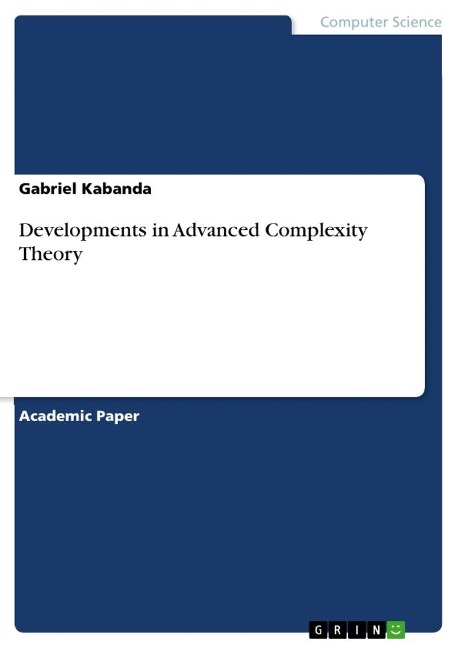
Developments in Advanced Complexity Theory - Gabriel Kabanda
-40% koodiga BOOKS
Saadetis 12-18 tööpäeva jooksul
30-päevane tagastamisõigus
Academic Paper from the year 2019 in the subject Computer Science - Software, grade: A, ( Atlantic International University ), language: English, abstract: This essay describes or analyses the content, style and merit of the developments in Advanced Complexity Theory. Complex, self-organising, adaptive systems possess a kind of dynamism that makes them qualitatively different from static objects such as com ... Täielik kirjeldus
Võib-olla meeldib sulle ka

 TOP
TOP

If Anyone Builds It, Everyone Dies: Why Superhuman AI Would Kill Us All
Eliezer Yudkowsky, Nate Soares
-40% koodiga BOOKS
Meie tarnija laos
TOP

Gödel, Escher, Bach: An Eternal Golden Braid
-40% koodiga BOOKS
Meie tarnija laos
TOP
AI Engineering: Building Applications with Foundation Models
-40% koodiga BOOKS
Meie tarnija laos
TOP


The Rust Programming Language
Steve Klabnik, Carol Nichols, Chris Krycho
-40% koodiga BOOKS
Meie tarnija laos
TOP

The Art of Game Design: A Book of Lenses
-40% koodiga BOOKS
Meie tarnija laos
TOP
How To Think About AI: A Guide For The Perplexed
-40% koodiga BOOKS
Meie tarnija laos
TOP
Empire of AI: Dreams and Nightmares in Sam Altman's OpenAI
-40% koodiga BOOKS
Meie tarnija laos
TOP

The Pragmatic Programmer: journey to mastery, 20th Anniversary Edition, 2/e: your journey to mastery, 20th Anniversary Edition
-40% koodiga BOOKS
Meie tarnija laos
TOP

HBR Guide to Generative AI for Managers
-40% koodiga BOOKS
Meie tarnija laos
TOP

Hackers. 25th Anniversary Edition: Heroes of the Computer Revolution
-40% koodiga BOOKS
Meie tarnija laos
TOP

The Web Application Hacker's Handbook: Discovering and Exploiting Security Flaws
-40% koodiga BOOKS
Meie tarnija laos
TOP

How Linux Works: What Every Superuser Should Know
-40% koodiga BOOKS
Meie tarnija laos
TOP
Artificial Intelligence: A Modern Approach, Global Edition
-40% koodiga BOOKS
Meie tarnija laos
TOP
Python Crash Course: A Hands-On, Project-Based Introduction to Programming
-40% koodiga BOOKS
Meie tarnija laos
TOP
Fundamentals of Software Architecture: A Modern Engineering Approach
-40% koodiga BOOKS
Meie tarnija laos
TOP
Speak Data: Artists, Scientists, Thinkers, and Dreamers on How We Live Our Lives in Numbers
-40% koodiga BOOKS
Meie tarnija laos
TOP

Linux Basics for Hackers, 2nd Edition: Getting Started with Networking, Scripting, and Security in Kali
-40% koodiga BOOKS
Meie tarnija laos
TOP
C Programming Language
Brian W. Kernighan, Brian Kernighan, Dennis Ritchie
-40% koodiga BOOKS
Meie tarnija laos
TOP

Proofs from THE BOOK
Martin Aigner, Günter M. Ziegler
-40% koodiga BOOKS
Meie tarnija laos
Kirjeldus
Academic Paper from the year 2019 in the subject Computer Science - Software, grade: A, ( Atlantic International University ), language: English, abstract: This essay describes or analyses the content, style and merit of the developments in Advanced Complexity Theory. Complex, self-organising, adaptive systems possess a kind of dynamism that makes them qualitatively different from static objects such as computer chips. Complex systems are more spontaneous, more disorderly, more alive than that. In the past three decades, chaos theory has shaken science to its foundations with the realisation that very simple dynamical systems can give rise to extraordinarily intricate behaviour. The edge of chaos is the constantly shifting battle zone between stagnation and anarchy, the one place where a complex system can be spontaneous, adaptive, and alive. Chaos theory is the qualitative study of unstable, aperiodic behaviour in deterministic, non-linear, dynamical systems. It is a specialised application of dynamical systems theory. Chaotic systems require impossible accuracy for useful prediction tasks. Chaos theory often seeks to understand the behaviour of a complex system by reconstructing its attractor, and knowing this attractor gives us qualitative understanding. Chaos theory includes theoretical hypotheses that assert relationships of qualitative (or topological) similarity between its abstract models and the actual systems it studies. Dynamics is used more as a source of qualitative insight than for making quantitative predictions. Its great value is its adaptability for constructing models of natural systems, which models can then be varied and analysed comparatively easily. Chaos theory is the quantitative study of dynamic non-linear system. Non-linear systems change with time and can demonstrate complex relationships between inputs and outputs due to reiterative feedback loops within the system. These systems are predictable but their behaviour is exquisitely sensitive to their starting point. Chaos is a sub-discipline of complexity. Complexity theory is the qualitative aspect drawing upon insights and metaphors that are derived from chaos theory.
Lisateave
| Autor | Gabriel Kabanda |
|---|---|
| Kirjastaja | GRIN Verlag |
| Väljalaskeaasta | 2019 |
| Kaanetüüp | Pehme kaanega |
| EAN | 9783668987586 |