
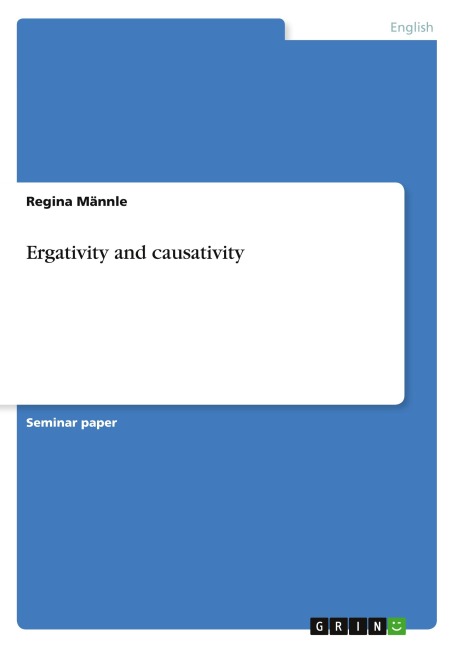
Ergativity and causativity - Regina Männle
-40% koodiga BOOKS
Saadetis 15-21 tööpäeva jooksul
30-päevane tagastamisõigus
Seminar paper from the year 2008 in the subject English Language and Literature Studies - Linguistics, grade: 1,0, University of Freiburg (English Department), course: The Syntax and Semantics of the English Verb Phrase, language: English, abstract: The term ¿ergativity¿ is used to describe a grammatical pattern in which there is a formal parallel between the object of a transitive clause and the subject of ... Täielik kirjeldus
Võib-olla meeldib sulle ka



 TOP
TOP

"Surely You're Joking, Mr. Feynman!": Adventures of a Curious Character
-40% koodiga BOOKS
Meie tarnija laos
TOP

Devotions: The Selected Poems of Mary Oliver
-40% koodiga BOOKS
Meie tarnija laos

 TOP
TOP

The Let Them Theory: A Life-Changing Tool That Millions of People Cant Stop Talking About
-40% koodiga BOOKS
Meie tarnija laos
 TOP
TOP

Kitchen Confidential: Adventures in the Culinary Underbelly
-40% koodiga BOOKS
Meie tarnija laos
TOP

Ocean: Earth's Last Wilderness
David Attenborough, Colin Butfield
-40% koodiga BOOKS
Meie tarnija laos



 TOP
TOP

Kitchen Confidential. 25th Anniversary Edition
-40% koodiga BOOKS
Meie tarnija laos
 TOP
TOP


We Did Ok, Kid: The Sunday Times bestselling memoir
-40% koodiga BOOKS
Meie tarnija laos

Kirjeldus
Seminar paper from the year 2008 in the subject English Language and Literature Studies - Linguistics, grade: 1,0, University of Freiburg (English Department), course: The Syntax and Semantics of the English Verb Phrase, language: English, abstract: The term ¿ergativity¿ is used to describe a grammatical pattern in which there is a formal parallel between the object of a transitive clause and the subject of an intransitive clause. The subject of the transitive clause, however, is treated differently. Dixon, in his standard survey of ergativity, uses the following symbols for these three elements: S = intransitive subject, A = transitive subject, and O = transitive object (1994:6). Initially, the term ¿ergativity¿ was only associated with case marking on constituents of a noun phrase. Manning summarises this as folllows: ¿The more patient-like argument of a transitive verb appears in the same absolutive case as the single argument of an intransitive verb, while the more agent-like argument of a transitive verb is marked differently, in what is known as the ergative case¿ (1996 : 3). Thus, ergativity is the counterpiece to accusativity, where one case is employed for the intransitive (S) and the transitive subject (A) (nominative) and another case marks the transitive object (O) (accusative). The term ¿ergativity¿ derives from the Greek words ergon ¿work, deed¿ and ergát¿s ¿doer (of an action)¿ (Bussmann 1996 : 151) and thus relates to the active ¿ the ¿more agent-like¿ ¿ member of the pair involved in a transitive structure. Dixon states that the first use of this term was in 1912 in a study on the Dagestanian language Rutul (1994 : 3).
Lisateave
| Autor | Regina Männle |
|---|---|
| Kirjastaja | GRIN Verlag |
| Väljalaskeaasta | 2008 |
| Kaanetüüp | Pehme kaanega |
| EAN | 9783640130405 |