
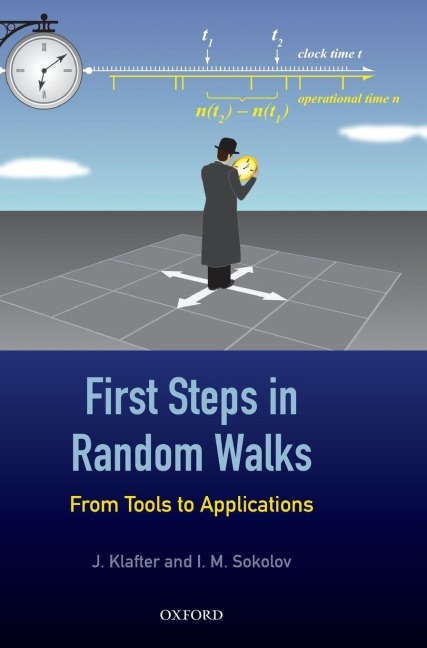
FIRST STEPS IN RANDOM WALKS C - Sokolov Klafter
-40% koodiga BOOKS
Saadetis 17-23 tööpäeva jooksul
30-päevane tagastamisõigus
The name "random walk" for a problem of a displacement of a point in a sequence of independent random steps was coined by Karl Pearson in 1905 in a question posed to readers of "Nature". The same year, a similar problem was formulated by Albert Einstein in one of his Annus Mirabilis works. Even earlier such a problem was posed by Louis Bachelier in his thesis devoted to the theory of financial speculations ... Täielik kirjeldus
Võib-olla meeldib sulle ka
 TOP
TOP

Determined: The Science of Life Without Free Will
-40% koodiga BOOKS
Meie tarnija laos
TOP

The Light Eaters: How the Unseen World of Plant Intelligence Offers a New Understanding of Life on Earth
-40% koodiga BOOKS
Meie tarnija laos
 TOP
TOP
Why We Sleep: Unlocking the Power of Sleep and Dreams
-40% koodiga BOOKS
Laos
TOP
The Rise and Fall of the Dinosaurs: A New History of a Lost World
-40% koodiga BOOKS
Meie tarnija laos
TOP

Biology: A Global Approach, Global Edition
Neil Campbell, Rebecca Orr, Lisa Urry, Peter Minorsky, Michael Cain, Jane Reece, Steven Wasserman
-40% koodiga BOOKS
Meie tarnija laos
TOP

Six Not-so-easy Pieces: Einstein's Relativity, Symmetry, and Space-Time
Richard P. Feynman, Robert B. Leighton, Matthew Sands
-40% koodiga BOOKS
Meie tarnija laos
TOP

Explaining AuDHD: The expert-led guide to Autism and ADHD Co-concurrence
-40% koodiga BOOKS
Meie tarnija laos
TOP


The Age of Alchemy: How Early Innovators Shaped Modern Chemistry
-40% koodiga BOOKS
Meie tarnija laos
TOP

The Secrets of our DNA: How Genetics has Changed the World
-40% koodiga BOOKS
Meie tarnija laos
TOP

How to Solve it: A New Aspect of Mathematical Method
-40% koodiga BOOKS
Meie tarnija laos
TOP

Factfulness: Ten Reasons We're Wrong About the World--and Why Things Are Better Than You Think
Ola Rosling, Anna Rosling Rönnlund, Hans Rosling
-40% koodiga BOOKS
Meie tarnija laos
TOP
Why Machines Learn: The Elegant Maths Behind Modern AI
-40% koodiga BOOKS
Meie tarnija laos
 TOP
TOP

Entangled Life: How Fungi Make Our Worlds, Change Our Minds and Shape Our Futures
-40% koodiga BOOKS
Meie tarnija laos
TOP

Life As No One Knows It: The Physics of Life's Emergence
-40% koodiga BOOKS
Meie tarnija laos
TOP
The Rise and Reign of the Mammals: A New History, from the Shadow of the Dinosaurs to Us
-40% koodiga BOOKS
Meie tarnija laos
TOP

Learn Faster, Perform Better: A Musician's Guide to the Neuroscience of Practicing
-40% koodiga BOOKS
Meie tarnija laos
TOP

Janeway's Immunobiology
Leslie J. Berg, Kenneth Murphy, Casey Weaver
-40% koodiga BOOKS
Meie tarnija laos
TOP

The Road to Reality: A Complete Guide to the Laws of the Universe
-40% koodiga BOOKS
Meie tarnija laos
Kirjeldus
The name "random walk" for a problem of a displacement of a point in a sequence of independent random steps was coined by Karl Pearson in 1905 in a question posed to readers of "Nature". The same year, a similar problem was formulated by Albert Einstein in one of his Annus Mirabilis works. Even earlier such a problem was posed by Louis Bachelier in his thesis devoted to the theory of financial speculations in 1900. Nowadays the theory of random walks has proved useful in physics and chemistry (diffusion, reactions, mixing in flows), economics, biology (from animal spread to motion of subcellular structures) and in many other disciplines. The random walk approach serves not only as a model of simple diffusion but of many complex sub- and super-diffusive transport processes as well. This book discusses the main variants of random walks and gives the most important mathematical tools for their theoretical description.
Lisateave
| Autor | Sokolov Klafter |
|---|---|
| Kirjastaja | ACADEMIC |
| Väljalaskeaasta | 2011 |
| Kaanetüüp | Kõvakaaneline |
| EAN | 9780199234868 |