
Foundations of Elastoplasticity: Subloading Surface Model - Koichi Hashiguchi
-40% koodiga BOOKS
Saadetis 12-18 tööpäeva jooksul
30-päevane tagastamisõigus
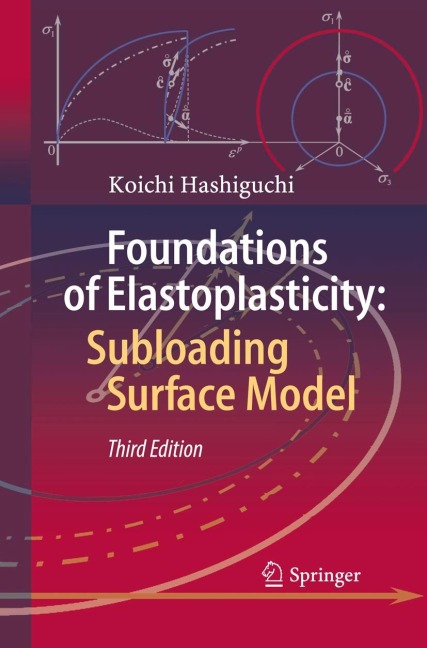
This book is the standard text book of elastoplasticity in which the elastoplasticity theory is comprehensively described from the conventional theory for the monotonic loading to the unconventional theory for the cyclic loading behavior. Explanations of vector-tensor analysis and continuum mechanics are provided first as a foundation for elastoplasticity theory, covering various strain and stress measures ... Täielik kirjeldus
Võib-olla meeldib sulle ka


 TOP
TOP

If Anyone Builds It, Everyone Dies: The Case Against Superintelligent AI
Eliezer Yudkowsky, Nate Soares
-40% koodiga BOOKS
Meie tarnija laos
 TOP
TOP

Open Circuits: The Inner Beauty of Electronic Components
Eric Schlaepfer, Windell Oskay
-40% koodiga BOOKS
Meie tarnija laos
TOP

Get started with MicroPython on Raspberry Pi Pico: The Official Raspberry Pi Pico Guide
-40% koodiga BOOKS
Meie tarnija laos
TOP


We Are Not Machines: The Fight for the Future of Work
-40% koodiga BOOKS
Meie tarnija laos
TOP

Foundations of Flavor: The Noma Guide to Fermentation: Including Step-By-Step Information on Making and Cooking with: Koji, Kombuchas, Shoyus, Misos, Vinegars, Garums, Lacto-Ferments and black Fruits Vegetables
-40% koodiga BOOKS
Meie tarnija laos
TOP

Nucleo Boards Programming with the STM32CubeIDE: Hands-on in more than 50 projects
-40% koodiga BOOKS
Meie tarnija laos
TOP

Data-Driven Science and Engineering: Machine Learning, Dynamical Systems, and Control
Steven L. Brunton, J. Nathan Kutz
-40% koodiga BOOKS
Meie tarnija laos
TOP

Fundamentals of Aerodynamics ISE
Christopher Cadou, John D. Anderson
-40% koodiga BOOKS
Meie tarnija laos
TOP

Black Holes: The Key to Understanding the Universe
-40% koodiga BOOKS
Meie tarnija laos
 TOP
TOP

Flowers For Algernon: A Modern Literary Classic
-40% koodiga BOOKS
Meie tarnija laos
TOP

Human Compatible: Artificial Intelligence and the Problem of Control
-40% koodiga BOOKS
Meie tarnija laos
TOP

How To Read Water: Clues & Patterns from Puddles to the Sea
-40% koodiga BOOKS
Meie tarnija laos
TOP

Make: Electronics: Learning by Discovery: A hands-on primer for the new electronics enthusiast
-40% koodiga BOOKS
Meie tarnija laos
TOP

Mastering the Arduino Uno R4: Programming and Projects for the Minima and WiFi
-40% koodiga BOOKS
Meie tarnija laos
TOP

The Idea Factory: Bell Labs and the Great Age of American Innovation
-40% koodiga BOOKS
Meie tarnija laos

Kirjeldus
This book is the standard text book of elastoplasticity in which the elastoplasticity theory is comprehensively described from the conventional theory for the monotonic loading to the unconventional theory for the cyclic loading behavior. Explanations of vector-tensor analysis and continuum mechanics are provided first as a foundation for elastoplasticity theory, covering various strain and stress measures and their rates with their objectivities. Elastoplasticity has been highly developed by the creation and formulation of the subloading surface model which is the unified fundamental law for irreversible mechanical phenomena in solids. The assumption that the interior of the yield surface is an elastic domain is excluded in order to describe the plastic strain rate due to the rate of stress inside the yield surface in this model aiming at the prediction of cyclic loading behavior, although the yield surface enclosing the elastic domain is assumed in allthe elastoplastic models other than the subloading surface model. Then, the plastic strain rate develops continuously as the stress approaches the yield surface, providing the advantages: 1) The tangent modulus changes continuously, 2) The yield judgment whether the stress reaches the yield surface is not required, 3) The stress is automatically attracted to the yield surface even when it goes out from the yield surface by large loading increments in numerical calculation and 4) The finite strain theory based on the multiplicative decomposition of deformation gradient tensor is formulated exactly. Consequently, the monotonic, the cyclic, the non-proportional loading behaviors for wide classes of materials including soils, rocks and concretes in addition to metals can be described rigorously by the subloading surface model. Further, the viscoplastic constitutive equations in a general rate from the quasi-static to the impact loadings are described, and constitutive equations of friction behavior and its application to the prediction of stick-slip phenomena, etc. are also described in detail. In addition, the return-mapping algorithm, the consistent tangent modulus, etc. are explained for the numerical analyses. Further, the damage, the phase-transformation and the crystal plasticity models are also described in brief. All of them are based on the subloading surface model. The elastoplasticity analysis will be advanced steadily based on the subloading surface model.
Lisateave
| Autor | Koichi Hashiguchi |
|---|---|
| Kirjastaja | Springer Nature Switzerland |
| Väljalaskeaasta | 2018 |
| Kaanetüüp | Pehme kaanega |
| EAN | 9783319840215 |