
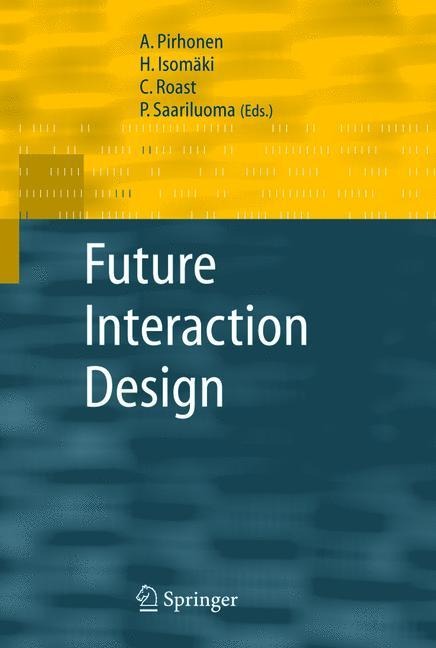
Future Interaction Design -
-30% koodiga BOOKS
Saadetis 12-18 tööpäeva jooksul
30-päevane tagastamisõigus
In 1969 Herbert Simon wrote a book, The Science of the Artificial, in which he argued that cognitive science should have its area of application in the design of devices. He proposed the foundation of a science of the artificial related with cognitive science in the sense in which we have traditionally understood the relationship between the engineering disciplines and the basic sciences. Such a science has ... Täielik kirjeldus
Võib-olla meeldib sulle ka
 TOP
TOP

Gödel, Escher, Bach: An Eternal Golden Braid
-30% koodiga BOOKS
Meie tarnija laos
TOP

If Anyone Builds It, Everyone Dies: Why Superhuman AI Would Kill Us All
Eliezer Yudkowsky, Nate Soares
-30% koodiga BOOKS
Meie tarnija laos
TOP
AI Engineering: Building Applications with Foundation Models
-30% koodiga BOOKS
Meie tarnija laos
TOP
Empire of AI: Dreams and Nightmares in Sam Altman's OpenAI
-30% koodiga BOOKS
Meie tarnija laos
TOP

The Pragmatic Programmer: journey to mastery, 20th Anniversary Edition, 2/e: your journey to mastery, 20th Anniversary Edition
-30% koodiga BOOKS
Meie tarnija laos
TOP


The Rust Programming Language
Steve Klabnik, Carol Nichols, Chris Krycho
-30% koodiga BOOKS
Meie tarnija laos
TOP

How Linux Works: What Every Superuser Should Know
-30% koodiga BOOKS
Meie tarnija laos
TOP
How To Think About AI: A Guide For The Perplexed
-30% koodiga BOOKS
Meie tarnija laos
TOP
Slanted 47 Digital Tools: Slanted Magazine
-30% koodiga BOOKS
Meie tarnija laos
TOP
The Art of Game Design: A Book of Lenses
-30% koodiga BOOKS
Meie tarnija laos
TOP
Artificial Intelligence: A Modern Approach, Global Edition
-30% koodiga BOOKS
Meie tarnija laos
TOP

Python Crash Course: A Hands-On, Project-Based Introduction to Programming
-30% koodiga BOOKS
Meie tarnija laos
TOP

CompTIA Security+ Certification Kit: Exam SY0-701
-30% koodiga BOOKS
Meie tarnija laos
 TOP
TOP
Fundamentals of Software Architecture: A Modern Engineering Approach
-30% koodiga BOOKS
Meie tarnija laos
TOP
Speak Data: Artists, Scientists, Thinkers, and Dreamers on How We Live Our Lives in Numbers
-30% koodiga BOOKS
Meie tarnija laos
 TOP
TOP

Linux Basics for Hackers, 2nd Edition: Getting Started with Networking, Scripting, and Security in Kali
-30% koodiga BOOKS
Meie tarnija laos
TOP

HBR Guide to Generative AI for Managers
-30% koodiga BOOKS
Meie tarnija laos
TOP

Hackers. 25th Anniversary Edition: Heroes of the Computer Revolution
-30% koodiga BOOKS
Meie tarnija laos
Kirjeldus
In 1969 Herbert Simon wrote a book, The Science of the Artificial, in which he argued that cognitive science should have its area of application in the design of devices. He proposed the foundation of a science of the artificial related with cognitive science in the sense in which we have traditionally understood the relationship between the engineering disciplines and the basic sciences. Such a science has been called cognitive ergonomics or cognitive engineering (Norman 1986). Simon¿s cognitive ergonomics (1969), would be independent of cognitive science, its basic science, although both would be closely related. Cognitive science would contribute knowledge on human cognitive processes, and cognitive ergonomics would contribute concrete problems of design that should be solved in the context of the creation of devices. Norman (1986), the author that coined the term cognitive engineering, conceived it as an applied cognitive science where the knowledge of cognitive science is combined with that of engineering to solve design problems. According to Norman, its objectives would be: (1) to understand the fundamental principles of human actions important for the development of the engineering of design principles, and (2) to build systems that are pleasant in their use.
Lisateave
| Kirjastaja | Springer London |
|---|---|
| Väljalaskeaasta | 2010 |
| Kaanetüüp | Pehme kaanega |
| EAN | 9781849969192 |