
Mathematical Analysis: An Introduction - Andrew Browder

-40% koodiga BOOKS
Saadetis 17-23 tööpäeva jooksul
30-päevane tagastamisõigus
This is a textbook suitable for a year-long course in analysis at the ad vanced undergraduate or possibly beginning-graduate level. It is intended for students with a strong background in calculus and linear algebra, and a strong motivation to learn mathematics for its own sake. At this stage of their education, such students are generally given a course in abstract algebra, and a course in analysis, which ... Täielik kirjeldus
Võib-olla meeldib sulle ka
 TOP
TOP

Determined: The Science of Life Without Free Will
-40% koodiga BOOKS
Meie tarnija laos
TOP

The Light Eaters: How the Unseen World of Plant Intelligence Offers a New Understanding of Life on Earth
-40% koodiga BOOKS
Meie tarnija laos
 TOP
TOP
Why We Sleep: Unlocking the Power of Sleep and Dreams
-40% koodiga BOOKS
Laos
TOP
The Rise and Fall of the Dinosaurs: A New History of a Lost World
-40% koodiga BOOKS
Meie tarnija laos
TOP

Biology: A Global Approach, Global Edition
Neil Campbell, Rebecca Orr, Lisa Urry, Peter Minorsky, Michael Cain, Jane Reece, Steven Wasserman
-40% koodiga BOOKS
Meie tarnija laos
TOP

Six Not-so-easy Pieces: Einstein's Relativity, Symmetry, and Space-Time
Richard P. Feynman, Robert B. Leighton, Matthew Sands
-40% koodiga BOOKS
Meie tarnija laos
TOP
Explaining AuDHD: The expert-led guide to Autism and ADHD Co-concurrence
-40% koodiga BOOKS
Meie tarnija laos
TOP


The Age of Alchemy: How Early Innovators Shaped Modern Chemistry
-40% koodiga BOOKS
Meie tarnija laos
TOP
The Secrets of our DNA: How Genetics has Changed the World
-40% koodiga BOOKS
Meie tarnija laos
TOP

How to Solve it: A New Aspect of Mathematical Method
-40% koodiga BOOKS
Meie tarnija laos
TOP
Factfulness: Ten Reasons We're Wrong About the World--and Why Things Are Better Than You Think
Ola Rosling, Anna Rosling Rönnlund, Hans Rosling
-40% koodiga BOOKS
Meie tarnija laos
TOP
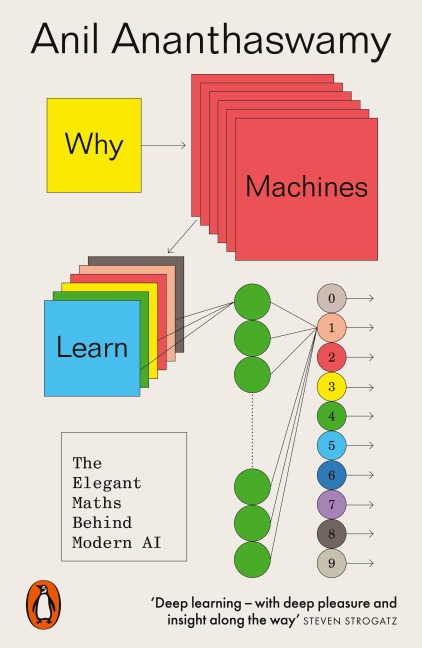
Why Machines Learn: The Elegant Maths Behind Modern AI
-40% koodiga BOOKS
Meie tarnija laos
TOP

The Feynman Lectures on Physics. The New Millennium Edition
Matthew Sands, Robert Leighton, Richard Feynman
-40% koodiga BOOKS
Meie tarnija laos
 TOP
TOP

Entangled Life: How Fungi Make Our Worlds, Change Our Minds and Shape Our Futures
-40% koodiga BOOKS
Meie tarnija laos
TOP

Life As No One Knows It: The Physics of Life's Emergence
-40% koodiga BOOKS
Meie tarnija laos
TOP
The Rise and Reign of the Mammals: A New History, from the Shadow of the Dinosaurs to Us
-40% koodiga BOOKS
Meie tarnija laos
TOP
Learn Faster, Perform Better: A Musician's Guide to the Neuroscience of Practicing
-40% koodiga BOOKS
Meie tarnija laos
TOP

Janeway's Immunobiology
Leslie J. Berg, Kenneth Murphy, Casey Weaver
-40% koodiga BOOKS
Meie tarnija laos
Kirjeldus
This is a textbook suitable for a year-long course in analysis at the ad vanced undergraduate or possibly beginning-graduate level. It is intended for students with a strong background in calculus and linear algebra, and a strong motivation to learn mathematics for its own sake. At this stage of their education, such students are generally given a course in abstract algebra, and a course in analysis, which give the fundamentals of these two areas, as mathematicians today conceive them. Mathematics is now a subject splintered into many specialties and sub specialties, but most of it can be placed roughly into three categories: al gebra, geometry, and analysis. In fact, almost all mathematics done today is a mixture of algebra, geometry and analysis, and some of the most in teresting results are obtained by the application of analysis to algebra, say, or geometry to analysis, in a fresh and surprising way. What then do these categories signify? Algebra is the mathematics that arises from the ancient experiences of addition and multiplication of whole numbers; it deals with the finite and discrete. Geometry is the mathematics that grows out of spatial experience; it is concerned with shape and form, and with measur ing, where algebra deals with counting.
Lisateave
| Autor | Andrew Browder |
|---|---|
| Kirjastaja | Springer US |
| Väljalaskeaasta | 1995 |
| Kaanetüüp | Kõvakaaneline |
| EAN | 9780387946146 |