
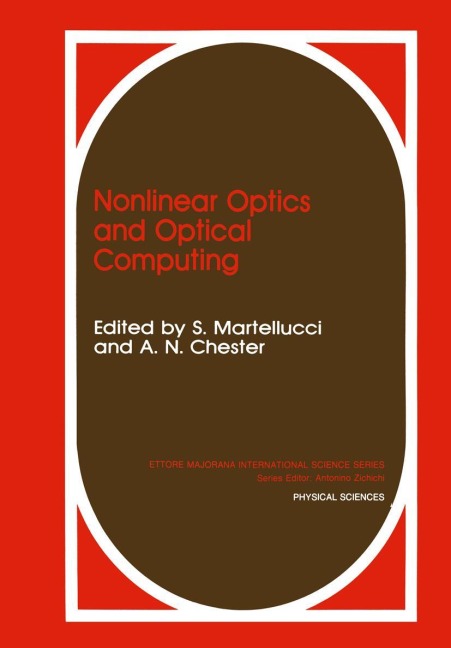
Nonlinear Optics and Optical Computing -
-40% koodiga BOOKS
Saadetis 12-18 tööpäeva jooksul
30-päevane tagastamisõigus
The conference "Nonlinear Optics and Optical Computing" was held May 11-19, 1988 in Erice, Sicily. This was the 13th conference organized by the International School of Quantum Electronics, under the auspices of the "Ettore Majorana" Center for Scientific Culture. This volume contains both the invited and contributed papers presented at the conference, providing tutorial background, the latest research resu ... Täielik kirjeldus
Võib-olla meeldib sulle ka
 TOP
TOP

Biology: A Global Approach, Global Edition
Neil Campbell, Rebecca Orr, Lisa Urry, Peter Minorsky, Michael Cain, Jane Reece, Steven Wasserman
-40% koodiga BOOKS
Meie tarnija laos
TOP

Six Not-so-easy Pieces: Einstein's Relativity, Symmetry, and Space-Time
Richard P. Feynman, Robert B. Leighton, Matthew Sands
-40% koodiga BOOKS
Meie tarnija laos
TOP

Determined: The Science of Life Without Free Will
-40% koodiga BOOKS
Meie tarnija laos
 TOP
TOP


The Age of Alchemy: How Early Innovators Shaped Modern Chemistry
-40% koodiga BOOKS
Meie tarnija laos
TOP
The Secrets of our DNA: How Genetics has Changed the World
-40% koodiga BOOKS
Meie tarnija laos
TOP

Janeway's Immunobiology
Leslie J. Berg, Kenneth Murphy, Casey Weaver
-40% koodiga BOOKS
Meie tarnija laos
TOP

Why We Sleep: Unlocking the Power of Sleep and Dreams
-40% koodiga BOOKS
Laos
TOP

The Light Eaters: How the Unseen World of Plant Intelligence Offers a New Understanding of Life on Earth
-40% koodiga BOOKS
Meie tarnija laos
TOP

Six Easy Pieces: Essentials of Physics Explained by Its Most Brilliant Teacher
Richard P. Feynman, Robert B. Leighton, Matthew Sands
-40% koodiga BOOKS
Meie tarnija laos
TOP
The Rise and Fall of the Dinosaurs: A New History of a Lost World
-40% koodiga BOOKS
Meie tarnija laos
TOP
The Rise and Reign of the Mammals: A New History, from the Shadow of the Dinosaurs to Us
-40% koodiga BOOKS
Meie tarnija laos
TOP

Learn Faster, Perform Better: A Musician's Guide to the Neuroscience of Practicing
-40% koodiga BOOKS
Meie tarnija laos
TOP
Why Machines Learn: The Elegant Maths Behind Modern AI
-40% koodiga BOOKS
Meie tarnija laos
TOP

Beyond Inheritance: Our Ever-Mutating Cells and a New Understanding of Health
-40% koodiga BOOKS
Meie tarnija laos
 TOP
TOP

The Feynman Lectures on Physics. The New Millennium Edition
Matthew Sands, Robert Leighton, Richard Feynman
-40% koodiga BOOKS
Meie tarnija laos
TOP

How to Solve it: A New Aspect of Mathematical Method
-40% koodiga BOOKS
Meie tarnija laos
TOP

Thing Explainer: Complicated Stuff in Simple Words
-40% koodiga BOOKS
Meie tarnija laos
TOP
Behave: The Biology of Humans at Our Best and Worst
-40% koodiga BOOKS
Meie tarnija laos
Kirjeldus
The conference "Nonlinear Optics and Optical Computing" was held May 11-19, 1988 in Erice, Sicily. This was the 13th conference organized by the International School of Quantum Electronics, under the auspices of the "Ettore Majorana" Center for Scientific Culture. This volume contains both the invited and contributed papers presented at the conference, providing tutorial background, the latest research results, and future directions for the devices, structures and architectures of optical computing. The invention of the transistor and the integrated circuit were followed by an explosion of application as ever faster and more complex microelectronics chips became available. The information revolution occa sioned by digital computers and optical communications is now reaching the limits of silicon semiconductor technology, but the demand for faster com putation is still accelerating. The fundamental limitations of information processing today derive from the performance and cost of three technical factors: speed, density, and software. Optical computation offers the potential for improvements in all three of these critical areas: Speed is provided by the transmission of impulses at optical veloc ities, without the delays caused by parasitic capacitance in the case of conventional electrical interconnects. Speed can also be achieved through the massive parallelism characteristic of many optical computing architec tures; Density can be provided in optical computers in two ways: by high spatial resolution, on the order of wavelengths of light, and by computa tion or interconnection in three dimensions.
Lisateave
| Kirjastaja | Springer New York |
|---|---|
| Series | Polymer Science and Technology Series |
| Väljalaskeaasta | 2013 |
| Kaanetüüp | Pehme kaanega |
| EAN | 9781461279006 |