
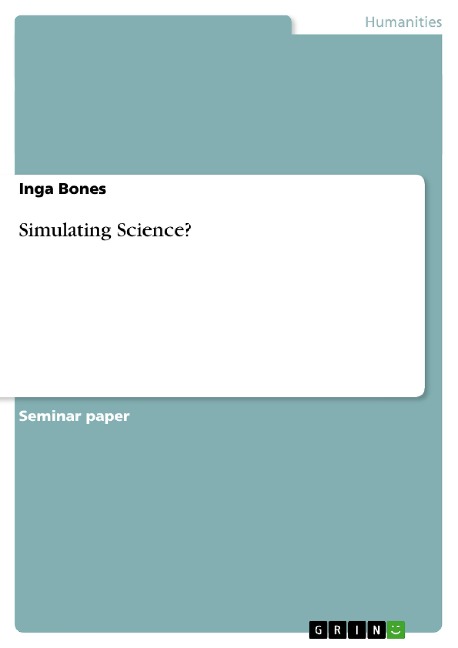
Simulating Science? - Inga Bones
-30% koodiga BOOKS
Saadetis 12-18 tööpäeva jooksul
30-päevane tagastamisõigus
Seminar paper from the year 2010 in the subject Philosophy - Theoretical (Realisation, Science, Logic, Language), grade: 1,0, University of Stuttgart (Institut für Philosophie/Wissenschaftstheorie/Technikphilosophie), course: HS Philosophy of Simulation, language: English, abstract: In the early 1980s, Robert Axelrod published several articles on The Evolution of Cooperation, discussing and interpreting the ... Täielik kirjeldus
Võib-olla meeldib sulle ka
 TOP
TOP
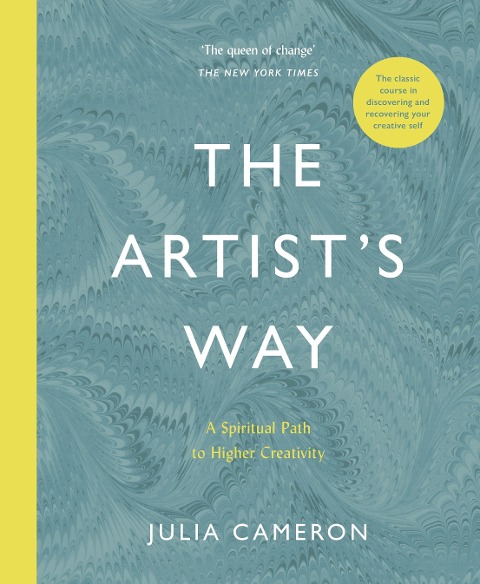
The Artist's Way: A Spiritual Path to Higher Creativity
-30% koodiga BOOKS
Meie tarnija laos
 TOP
TOP

The Power of Now: A Guide to Spiritual Enlightenment
-30% koodiga BOOKS
Laos
TOP

The Holy Bible - King James Version (KJV): Popular Gift & Award Black Leatherette Edition
-30% koodiga BOOKS
Meie tarnija laos
TOP
How Not to Be Wrong: The Power of Mathematical Thinking
-30% koodiga BOOKS
Meie tarnija laos
TOP
The Daily Stoic: 366 Meditations on Wisdom, Perseverance, and the Art of Living: Featuring new translations of Seneca, Epictetus, and Marcus Aurelius
Stephen Hanselman, Ryan Holiday
-30% koodiga BOOKS
Laos
TOP

Ikigai: The Japanese secret to a long and happy life
Francesc Miralles, Héctor García
-30% koodiga BOOKS
Laos
TOP


Original Sin: The Genetics of Wrongdoing, the Problem of Blame and the Future of Forgiveness
-30% koodiga BOOKS
Meie tarnija laos
TOP

Antifragile: Things That Gain from Disorder
-30% koodiga BOOKS
Meie tarnija laos
TOP

The Art of War & Other Classics of Eastern Philosophy
Mencius, Lao-Tzu, Confucius, Sun Tzu
-30% koodiga BOOKS
Meie tarnija laos

 TOP
TOP
The 5 Levels of Leadership: Proven Steps to Maximize Your Potential
-30% koodiga BOOKS
Meie tarnija laos
TOP

The Café on the Edge of the World: A Story About the Meaning of Life
-30% koodiga BOOKS
Meie tarnija laos
TOP
Open Socrates: The Case for a Philosophical Life
-30% koodiga BOOKS
Meie tarnija laos
TOP

The Reed of God: Mary, Virgin and Mother
-30% koodiga BOOKS
Meie tarnija laos

 TOP
TOP
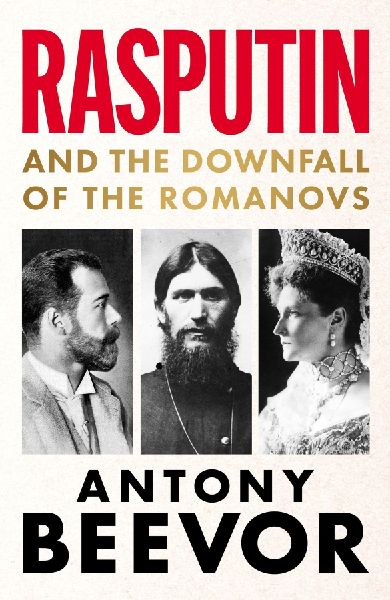
Rasputin: And the Downfall of the Romanovs
-30% koodiga BOOKS
Meie tarnija laos
Kirjeldus
Seminar paper from the year 2010 in the subject Philosophy - Theoretical (Realisation, Science, Logic, Language), grade: 1,0, University of Stuttgart (Institut für Philosophie/Wissenschaftstheorie/Technikphilosophie), course: HS Philosophy of Simulation, language: English, abstract: In the early 1980s, Robert Axelrod published several articles on The Evolution of Cooperation, discussing and interpreting the results of his well-known computer tournaments and of a series of subsequent simulations. Both the tournaments and simulations were conducted in order to find a suitable, evolutionary stable strategy for the iterated prisoner's dilemma, which is generally considered an appropriate model of a certain type of social dilemma that arises when "the pursuit of self-interest by each leads to a poor outcome for all." The results of the tournaments and simulations led to a generalized theory of the evolution of cooperation, which claims to provide an explanation for various historical, social and biological phenomena. Axelrod`s work contributed extensively to popularizing computer simulation as a scientific method in the social sciences. Besides the fact that his approach had an unquestionably high impact on succeeding research and ushered in the "simulation era" in the social sciences, the use Axelrod made of computer simulations raises questions about their methodological and epistemological status: If, as Axelrod states in his paper "Advancing the Art of Simulation in the Social Sciences", simulation can serve the purposes of prediction, proof and even scientific discovery, what need is there for conducting experiments any longer? Can't we simulate science? Admittedly, this suggestion sounds somewhat exaggerated, but why exactly do most of us share the intuition that there are fundamental differences persisting between simulations and experiments? What are the characteristic features distinguishing them? Do computer simulations in general - and Axelrod's tournaments in particular - resemble experiments insofar as their potential to provide us with surprising results that permit further theorizing is concerned? Or are they nothing else than mere "number-crunching techniques", using brute-force computational means in order to generate data from theoretical knowledge and assumptions already built into the underlying model? The question where to draw the conceptual line between simulation and experiment has turned out to be of great interest to philosophy of science, not least since the categorization might be relevant to the way the results are assessed and used. The objective of this paper is to elaborate on the distinctive characteristics of simulations in contrast to experiments.
Lisateave
| Autor | Inga Bones |
|---|---|
| Kirjastaja | GRIN Verlag |
| Väljalaskeaasta | 2010 |
| Kaanetüüp | Pehme kaanega |
| EAN | 9783640602230 |