
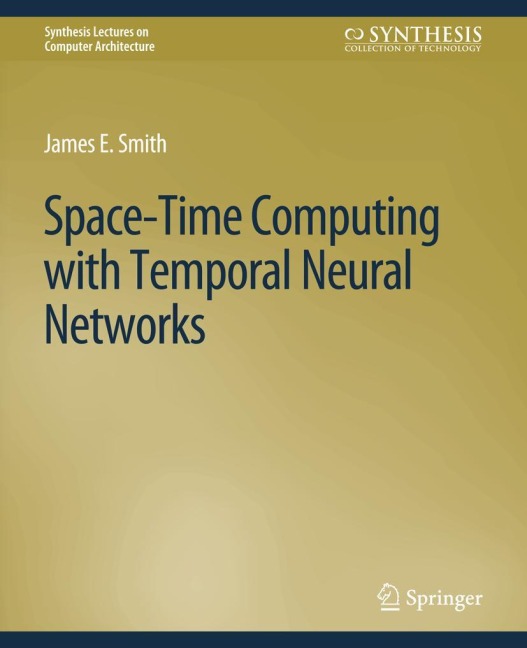
Space-Time Computing with Temporal Neural Networks - James E. Smith
-40% koodiga BOOKS
Saadetis 12-18 tööpäeva jooksul
30-päevane tagastamisõigus
Understanding and implementing the brain's computational paradigm is the one true grand challenge facing computer researchers. Not only are the brain's computational capabilities far beyond those of conventional computers, its energy efficiency is truly remarkable. This book, written from the perspective of a computer designer and targeted at computer researchers, is intended to give both background and lay ... Täielik kirjeldus
Võib-olla meeldib sulle ka


 TOP
TOP

If Anyone Builds It, Everyone Dies: The Case Against Superintelligent AI
Eliezer Yudkowsky, Nate Soares
-40% koodiga BOOKS
Meie tarnija laos
 TOP
TOP
Open Circuits: The Inner Beauty of Electronic Components
Eric Schlaepfer, Windell Oskay
-40% koodiga BOOKS
Meie tarnija laos
TOP
Get started with MicroPython on Raspberry Pi Pico: The Official Raspberry Pi Pico Guide
-40% koodiga BOOKS
Meie tarnija laos
TOP


We Are Not Machines: The Fight for the Future of Work
-40% koodiga BOOKS
Meie tarnija laos
 TOP
TOP

Nucleo Boards Programming with the STM32CubeIDE: Hands-on in more than 50 projects
-40% koodiga BOOKS
Meie tarnija laos
TOP

Fundamentals of Aerodynamics ISE
Christopher Cadou, John D. Anderson
-40% koodiga BOOKS
Meie tarnija laos
TOP

Black Holes: The Key to Understanding the Universe
-40% koodiga BOOKS
Meie tarnija laos
TOP

Flowers For Algernon: A Modern Literary Classic
-40% koodiga BOOKS
Meie tarnija laos
TOP

Human Compatible: Artificial Intelligence and the Problem of Control
-40% koodiga BOOKS
Meie tarnija laos
TOP

How To Read Water: Clues & Patterns from Puddles to the Sea
-40% koodiga BOOKS
Meie tarnija laos
TOP

Foundations of Flavor: The Noma Guide to Fermentation: Including Step-By-Step Information on Making and Cooking with: Koji, Kombuchas, Shoyus, Misos, Vinegars, Garums, Lacto-Ferments and black Fruits Vegetables
-40% koodiga BOOKS
Meie tarnija laos
TOP

Make: Electronics: Learning by Discovery: A hands-on primer for the new electronics enthusiast
-40% koodiga BOOKS
Meie tarnija laos
TOP
Data-Driven Science and Engineering: Machine Learning, Dynamical Systems, and Control
Steven L. Brunton, J. Nathan Kutz
-40% koodiga BOOKS
Meie tarnija laos
TOP

The Idea Factory: Bell Labs and the Great Age of American Innovation
-40% koodiga BOOKS
Meie tarnija laos


Kirjeldus
Understanding and implementing the brain's computational paradigm is the one true grand challenge facing computer researchers. Not only are the brain's computational capabilities far beyond those of conventional computers, its energy efficiency is truly remarkable. This book, written from the perspective of a computer designer and targeted at computer researchers, is intended to give both background and lay out a course of action for studying the brain's computational paradigm. It contains a mix of concepts and ideas drawn from computational neuroscience, combined with those of the author. As background, relevant biological features are described in terms of their computational and communication properties. The brain's neocortex is constructed of massively interconnected neurons that compute and communicate via voltage spikes, and a strong argument can be made that precise spike timing is an essential element of the paradigm. Drawing from the biological features, a mathematics-based computational paradigm is constructed. The key feature is spiking neurons that perform communication and processing in space-time, with emphasis on time. In these paradigms, time is used as a freely available resource for both communication and computation. Neuron models are first discussed in general, and one is chosen for detailed development. Using the model, single-neuron computation is first explored. Neuron inputs are encoded as spike patterns, and the neuron is trained to identify input pattern similarities. Individual neurons are building blocks for constructing larger ensembles, referred to as "columns". These columns are trained in an unsupervised manner and operate collectively to perform the basic cognitive function of pattern clustering. Similar input patterns are mapped to a much smaller set of similar output patterns, thereby dividing the input patterns into identifiable clusters. Larger cognitive systems are formed by combining columns into a hierarchical architecture. These higher level architectures are the subject of ongoing study, and progress to date is described in detail in later chapters. Simulation plays a major role in model development, and the simulation infrastructure developed by the author is described.
Lisateave
| Autor | James E. Smith |
|---|---|
| Kirjastaja | Springer Nature Switzerland |
| Series | Synthesis Lectures on Computer Architecture |
| Väljalaskeaasta | 2017 |
| Kaanetüüp | Pehme kaanega |
| EAN | 9783031006265 |