
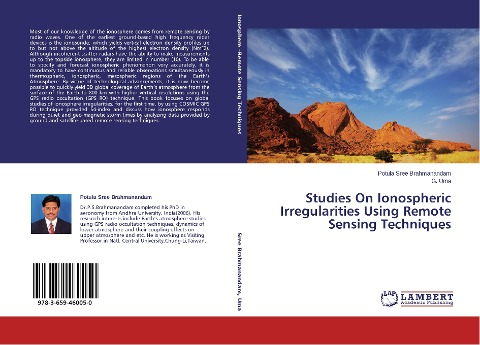
Studies On Ionospheric Irregularities Using Remote Sensing Techniques - G. Uma,Potula Sree Brahmanandam
-40% koodiga BOOKS
Saadetis 12-18 tööpäeva jooksul
30-päevane tagastamisõigus
Most of our knowledge of the ionosphere comes from remote sensing by radio waves. One of the earliest ground-based high frequency radar devices is the ionosonde, which yields vertical electron density profiles up to but not above the altitude of the highest electron density (NmF2). Although incoherent scatter radars have the ability to make measurements up to the topside ionosphere, they are limited in numb ... Täielik kirjeldus
Võib-olla meeldib sulle ka
 TOP
TOP

Determined: The Science of Life Without Free Will
-40% koodiga BOOKS
Meie tarnija laos
TOP

The Light Eaters: How the Unseen World of Plant Intelligence Offers a New Understanding of Life on Earth
-40% koodiga BOOKS
Meie tarnija laos
 TOP
TOP

Why We Sleep: Unlocking the Power of Sleep and Dreams
-40% koodiga BOOKS
Laos
TOP
The Rise and Fall of the Dinosaurs: A New History of a Lost World
-40% koodiga BOOKS
Meie tarnija laos
TOP

Biology: A Global Approach, Global Edition
Neil Campbell, Rebecca Orr, Lisa Urry, Peter Minorsky, Michael Cain, Jane Reece, Steven Wasserman
-40% koodiga BOOKS
Meie tarnija laos
TOP

Six Not-so-easy Pieces: Einstein's Relativity, Symmetry, and Space-Time
Richard P. Feynman, Robert B. Leighton, Matthew Sands
-40% koodiga BOOKS
Meie tarnija laos
TOP

Explaining AuDHD: The expert-led guide to Autism and ADHD Co-concurrence
-40% koodiga BOOKS
Lõppenud
TOP


The Age of Alchemy: How Early Innovators Shaped Modern Chemistry
-40% koodiga BOOKS
Meie tarnija laos
TOP

Factfulness: Ten Reasons We're Wrong About the World--and Why Things Are Better Than You Think
Ola Rosling, Anna Rosling Rönnlund, Hans Rosling
-40% koodiga BOOKS
Meie tarnija laos
TOP
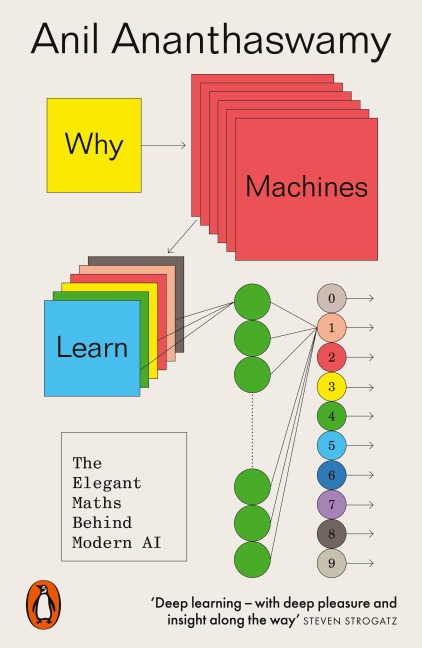
Why Machines Learn: The Elegant Maths Behind Modern AI
-40% koodiga BOOKS
Meie tarnija laos
 TOP
TOP

Entangled Life: How Fungi Make Our Worlds, Change Our Minds and Shape Our Futures
-40% koodiga BOOKS
Meie tarnija laos
TOP

Life As No One Knows It: The Physics of Life's Emergence
-40% koodiga BOOKS
Meie tarnija laos
TOP
The Rise and Reign of the Mammals: A New History, from the Shadow of the Dinosaurs to Us
-40% koodiga BOOKS
Meie tarnija laos
TOP

Molecular Biology of the Cell
David Morgan, Alexander Johnson, Rebecca Heald, Bruce Alberts, Martin Raff
-40% koodiga BOOKS
Meie tarnija laos
TOP

Learn Faster, Perform Better: A Musician's Guide to the Neuroscience of Practicing
-40% koodiga BOOKS
Meie tarnija laos
TOP

Janeway's Immunobiology
Leslie J. Berg, Kenneth Murphy, Casey Weaver
-40% koodiga BOOKS
Meie tarnija laos
TOP

The Road to Reality: A Complete Guide to the Laws of the Universe
-40% koodiga BOOKS
Meie tarnija laos
TOP

The Brain That Changes Itself: Stories of Personal Triumph from the Frontiers of Brain Science
-40% koodiga BOOKS
Meie tarnija laos
Kirjeldus
Most of our knowledge of the ionosphere comes from remote sensing by radio waves. One of the earliest ground-based high frequency radar devices is the ionosonde, which yields vertical electron density profiles up to but not above the altitude of the highest electron density (NmF2). Although incoherent scatter radars have the ability to make measurements up to the topside ionosphere, they are limited in number (10). To be able to specify and forecast ionospheric phenomenon very accurately, it is mandatory to have continuous and reliable observations simultaneously in thermospheric, ionospheric, mesospheric regions of the Earth¿s Atmosphere. By virtue of technological advancements, it is now become possible to quickly yield 3D global coverage of Earth¿s atmosphere from the surface of the Earth to 800 km with higher vertical resolutions using the GPS radio occultation (GPS RO) technique. This book focuses on global studies of ionosphere irregularities, for the first time, by using COSMIC GPS RO technique provided S4-index and discuss how ionosphere responds during quiet and geo-magnetic storm times by analyzing data provided by ground and satellite-based remote sensing techniques.
Lisateave
| Autor | G. Uma, Potula Sree Brahmanandam |
|---|---|
| Kirjastaja | LAP LAMBERT Academic Publishing |
| Väljalaskeaasta | 2013 |
| Kaanetüüp | Pehme kaanega |
| EAN | 9783659460050 |