
Syntactic Movements - Mergim Bytyci
-40% koodiga BOOKS
Saadetis 12-18 tööpäeva jooksul
30-päevane tagastamisõigus
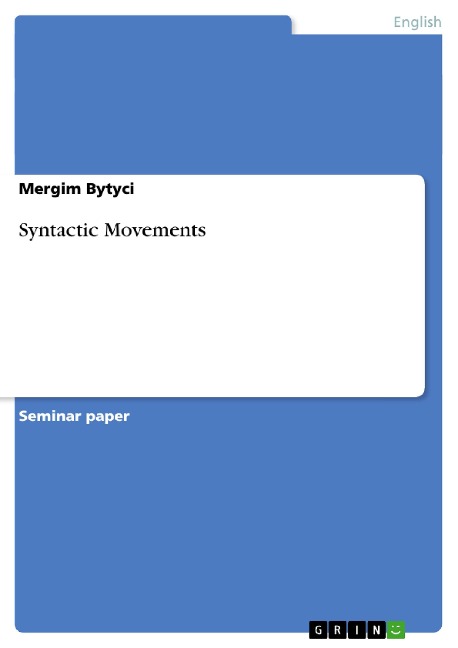
Seminar paper from the year 2008 in the subject English Language and Literature Studies - Linguistics, grade: 2.0, Technical University of Braunschweig, language: English, abstract: 1. Introduction In the course of this term paper I will analyze three kinds of syntactic movements, which will be the Head Movement, Argument Movement and the Wh-Movement. Initially I will defer to basic knowledge such as Featur ... Täielik kirjeldus
Võib-olla meeldib sulle ka


 TOP
TOP


The Traveller (Traveler): The Revolutionary Life of George Forster and his Search for Humanity
-40% koodiga BOOKS
Meie tarnija laos

 TOP
TOP

Devotions: The Selected Poems of Mary Oliver
-40% koodiga BOOKS
Meie tarnija laos
 TOP
TOP

The Let Them Theory: A Life-Changing Tool That Millions of People Cant Stop Talking About
-40% koodiga BOOKS
Meie tarnija laos
 TOP
TOP

Kitchen Confidential: Adventures in the Culinary Underbelly
-40% koodiga BOOKS
Meie tarnija laos
TOP

Ocean: Earth's Last Wilderness
David Attenborough, Colin Butfield
-40% koodiga BOOKS
Meie tarnija laos
 TOP
TOP

London Falling: A Mysterious Death in a Gilded City and a Family's Search for Truth
-40% koodiga BOOKS
Meie tarnija laos

 TOP
TOP

Kitchen Confidential. 25th Anniversary Edition
-40% koodiga BOOKS
Meie tarnija laos

 TOP
TOP

We Did Ok, Kid: The Sunday Times bestselling memoir
-40% koodiga BOOKS
Meie tarnija laos

Kirjeldus
Seminar paper from the year 2008 in the subject English Language and Literature Studies - Linguistics, grade: 2.0, Technical University of Braunschweig, language: English, abstract: 1. Introduction In the course of this term paper I will analyze three kinds of syntactic movements, which will be the Head Movement, Argument Movement and the Wh-Movement. Initially I will defer to basic knowledge such as Feature Checking, Merge and C-Command since these operations are the basis of syntactic comprehension. After a short introduction I will briefly discuss and explain the Head Movement and the Argument Movement with the help of examples before I focus on the latter, namely the Wh-Movement. This syntactic operation will be the core of this paper. I will try to analyze the latest concepts and approaches to this issue and try to illustrate the way Wh-Movement takes place by several examples. I decided to concentrate on Adger¿s and Radford¿s points of view on this topic since they rate among the most accepted syntacticians worldwide. Despite this I will parse their statements very closely and try to find potential differences or grievances. An interesting question will be whether all operations can be explained in a plausible way or if there are arbitrary assumptions without any evidence. 2. Feature Checking Syntacticians assume that every word of a sentence bears certain features. These features are called categorial-selectional (or c-selectional) features and can be either interpretable or uninterpretable. A noun, for example, bears an interpretable feature [N], a verb [V], an adverbial [Adv] and a preposition the feature [P]. A verb cannot stand alone in a sentence but it needs the existence of a subject. In order to explain this phenomenon linguists came to the assumption that a verb has to bear uninterpretable features as well. Since a verb needs the presence of a subject, which usually is a DP, it is assumed that the verb bears next to the interpretable feature [V] the uninterpretable feature [N] (abbreviated [uN]). 2.1 Merge This uninterpretable feature has to be checked and deleted in order to form a grammatically correct sentence. This happens via the operation of Merge. Merge can only
Lisateave
| Autor | Mergim Bytyci |
|---|---|
| Kirjastaja | GRIN Verlag |
| Väljalaskeaasta | 2009 |
| Kaanetüüp | Pehme kaanega |
| EAN | 9783640420247 |