
Theoretical physicists -
-40% koodiga BOOKS
Saadetis 12-18 tööpäeva jooksul
30-päevane tagastamisõigus
Source: Wikipedia. Pages: 143. Chapters: Galileo Galilei, Werner Heisenberg, J. Robert Oppenheimer, Isaac Newton, Albert Einstein, Abdus Salam, Richard Feynman, Pierre-Simon Laplace, Basil Hiley, Josiah Willard Gibbs, James Clerk Maxwell, Stephen Hawking, Paul Dirac, Freeman Dyson, Max Born, Enrico Fermi, Niels Bohr, Jack Sarfatti, Max Planck, Riazuddin (physicist). Excerpt: Galileo Galilei (Italian pronunc ... Täielik kirjeldus
Võib-olla meeldib sulle ka
 TOP
TOP
Biology: A Global Approach, Global Edition
Neil Campbell, Rebecca Orr, Lisa Urry, Peter Minorsky, Michael Cain, Jane Reece, Steven Wasserman
-40% koodiga BOOKS
Meie tarnija laos
TOP

Six Not-so-easy Pieces: Einstein's Relativity, Symmetry, and Space-Time
Richard P. Feynman, Robert B. Leighton, Matthew Sands
-40% koodiga BOOKS
Meie tarnija laos
TOP

Determined: The Science of Life Without Free Will
-40% koodiga BOOKS
Meie tarnija laos
 TOP
TOP

The Age of Alchemy: How Early Innovators Shaped Modern Chemistry
-40% koodiga BOOKS
Meie tarnija laos
TOP
The Secrets of our DNA: How Genetics has Changed the World
-40% koodiga BOOKS
Meie tarnija laos
TOP

Janeway's Immunobiology
Leslie J. Berg, Kenneth Murphy, Casey Weaver
-40% koodiga BOOKS
Meie tarnija laos
TOP

How to Solve it: A New Aspect of Mathematical Method
-40% koodiga BOOKS
Meie tarnija laos
TOP
Why We Sleep: Unlocking the Power of Sleep and Dreams
-40% koodiga BOOKS
Laos
TOP
The Light Eaters: How the Unseen World of Plant Intelligence Offers a New Understanding of Life on Earth
-40% koodiga BOOKS
Meie tarnija laos
TOP

Six Easy Pieces: Essentials of Physics Explained by Its Most Brilliant Teacher
Richard P. Feynman, Robert B. Leighton, Matthew Sands
-40% koodiga BOOKS
Meie tarnija laos
TOP
The Rise and Fall of the Dinosaurs: A New History of a Lost World
-40% koodiga BOOKS
Meie tarnija laos
TOP
The Rise and Reign of the Mammals: A New History, from the Shadow of the Dinosaurs to Us
-40% koodiga BOOKS
Meie tarnija laos
TOP
Learn Faster, Perform Better: A Musician's Guide to the Neuroscience of Practicing
-40% koodiga BOOKS
Meie tarnija laos
TOP
Why Machines Learn: The Elegant Maths Behind Modern AI
-40% koodiga BOOKS
Meie tarnija laos
TOP

Beyond Inheritance: Our Ever-Mutating Cells and a New Understanding of Health
-40% koodiga BOOKS
Meie tarnija laos
 TOP
TOP

The Feynman Lectures on Physics. The New Millennium Edition
Matthew Sands, Robert Leighton, Richard Feynman
-40% koodiga BOOKS
Meie tarnija laos
TOP

Thing Explainer: Complicated Stuff in Simple Words
-40% koodiga BOOKS
Meie tarnija laos
TOP
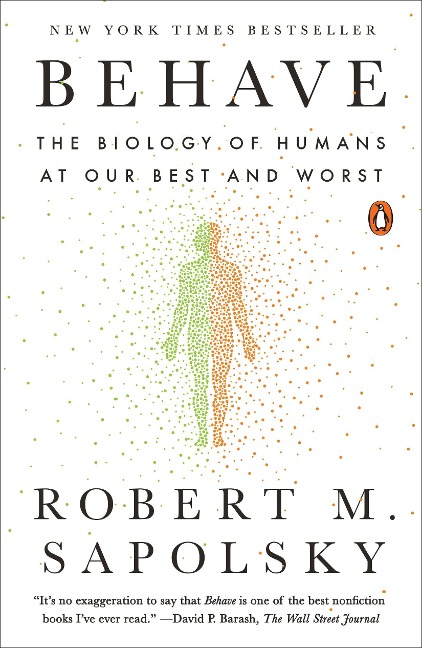
Behave: The Biology of Humans at Our Best and Worst
-40% koodiga BOOKS
Meie tarnija laos
Kirjeldus
Source: Wikipedia. Pages: 143. Chapters: Galileo Galilei, Werner Heisenberg, J. Robert Oppenheimer, Isaac Newton, Albert Einstein, Abdus Salam, Richard Feynman, Pierre-Simon Laplace, Basil Hiley, Josiah Willard Gibbs, James Clerk Maxwell, Stephen Hawking, Paul Dirac, Freeman Dyson, Max Born, Enrico Fermi, Niels Bohr, Jack Sarfatti, Max Planck, Riazuddin (physicist). Excerpt: Galileo Galilei (Italian pronunciation: ; 15 February 1564 ¿ 8 January 1642), was an Italian physicist, mathematician, astronomer, and philosopher who played a major role in the Scientific Revolution. His achievements include improvements to the telescope and consequent astronomical observations and support for Copernicanism. Galileo has been called the "father of modern observational astronomy", the "father of modern physics", the "father of science", and "the Father of Modern Science". His contributions to observational astronomy include the telescopic confirmation of the phases of Venus, the discovery of the four largest satellites of Jupiter (named the Galilean moons in his honour), and the observation and analysis of sunspots. Galileo also worked in applied science and technology, inventing an improved military compass and other instruments. Galileo's championing of heliocentrism was controversial within his lifetime, when most subscribed to either geocentrism or the Tychonic system. He met with opposition from astronomers, who doubted heliocentrism due to the absence of an observed stellar parallax. The matter was investigated by the Roman Inquisition in 1615, and they concluded that it could be supported as only a possibility, not an established fact. Galileo later defended his views in Dialogue Concerning the Two Chief World Systems, which appeared to attack Pope Urban VIII and thus alienated him and the Jesuits, who had both supported Galileo up until this point. He was tried by the Inquisition, found "vehemently suspect of heresy", forced to recant, and spent the rest of his life under house arrest. It was while Galileo was under house arrest that he wrote one of his finest works, Two New Sciences, in which he summarised the work he had done some forty years earlier, on the two sciences now called kinematics and strength of materials. Galileo was born in Pisa (then part of the Duchy of Florence), Italy, the first of six children of Vincenzo Galilei, a famo
Lisateave
| Kirjastaja | Books LLC, Reference Series |
|---|---|
| Väljalaskeaasta | 2014 |
| Kaanetüüp | Pehme kaanega |
| EAN | 9781151048813 |