
Uncultivated Microorganisms -
-40% koodiga BOOKS
Saadetis 17-23 tööpäeva jooksul
30-päevane tagastamisõigus
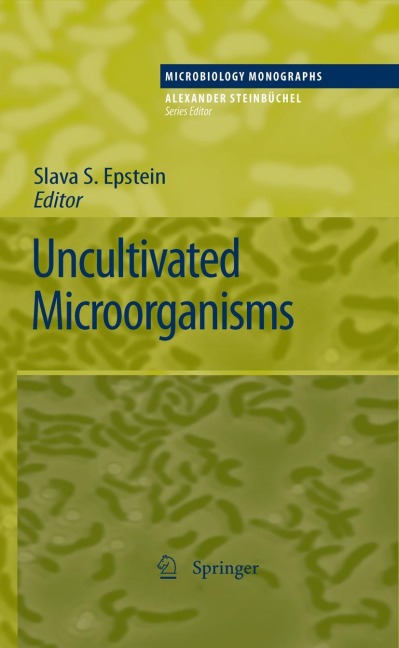
In 1898, an Austrian microbiologist Heinrich Winterberg made a curious observation: the number of microbial cells in his samples did not match the number of colonies formed on nutrient media (Winterberg 1898). About a decade later, J. Amann qu- tified this mismatch, which turned out to be surprisingly large, with non-growing cells outnumbering the cultivable ones almost 150 times (Amann 1911). These papers ... Täielik kirjeldus
Võib-olla meeldib sulle ka
 TOP
TOP

The Myth of Normal: Trauma, Illness, and Healing in a Toxic Culture
-40% koodiga BOOKS
Meie tarnija laos
TOP
No Bad Parts: Healing Trauma and Restoring Wholeness with the Internal Family Systems Model
-40% koodiga BOOKS
Meie tarnija laos
 TOP
TOP
Harrison's Principles of Internal Medicine (Vol.1 & Vol.2)
Stephen Hauser, Joseph Loscalzo, Steven Holland, Dan Longo, J. Larry Jameson, Dennis Kasper, Carol Langford, Anthony Fauci
-40% koodiga BOOKS
Meie tarnija laos
TOP

The Body Keeps the Score: Brain, Mind, and Body in the Healing of Trauma
-40% koodiga BOOKS
Meie tarnija laos
 TOP
TOP

Maybe You Should Talk to Someone: a therapist, her thearapist, and our lives revealed
-40% koodiga BOOKS
Meie tarnija laos
TOP

How Not To Die: Discover the foods scientifically proven to prevent and reverse disease
-40% koodiga BOOKS
Meie tarnija laos
TOP

Lifespan: Why We Age - and Why We Don't Have To
-40% koodiga BOOKS
Meie tarnija laos
TOP
Vademecum Metabolicum: Diagnosis and Treatment of Inborn Errors of Metabolism Forword by William L. Nyhan, San Diego, USA
Johannes Zschocke, Georg F. Hoffmann
-40% koodiga BOOKS
Meie tarnija laos
TOP

Cellular and Molecular Immunology
Sarah Henrickson, Abul K. Abbas, Andrew H. Lichtman, Shiv Pillai
-40% koodiga BOOKS
Meie tarnija laos
TOP
Physics, Pharmacology and Physiology for Anaesthetists: Key Concepts for the FRCA
Matthew E. Cross, Emma V. E. Plunkett
-40% koodiga BOOKS
Meie tarnija laos
TOP

Pocket Guide to Teaching for Clinical Instructors
-40% koodiga BOOKS
Meie tarnija laos
TOP

Oxford Handbook of Critical Care
Andrew Webb, Mervyn Singer, Alice Carter
-40% koodiga BOOKS
Meie tarnija laos
TOP

The Wills Eye Manual: Print + eBook with Multimedia: Office and Emergency Room Diagnosis and Treatment of Eye Disease
-40% koodiga BOOKS
Meie tarnija laos
TOP


Who Deserves Your Love: How to Create Boundaries to Start, Strengthen or End Any Relationship
-40% koodiga BOOKS
Meie tarnija laos
TOP
Vaccinated - dead: Histopathological findings following COVID-19 vaccination
-40% koodiga BOOKS
Meie tarnija laos
TOP

Nine Months That Count Forever: How your pregnancy diet shapes your baby's future
-40% koodiga BOOKS
Meie tarnija laos
TOP

Steal Like an Artist: 10 Things Nobody Told You About Being Creative
-40% koodiga BOOKS
Meie tarnija laos
TOP

It Didn't Start with You: How Inherited Family Trauma Shapes Who We Are and How to End the Cycle
-40% koodiga BOOKS
Meie tarnija laos
Kirjeldus
In 1898, an Austrian microbiologist Heinrich Winterberg made a curious observation: the number of microbial cells in his samples did not match the number of colonies formed on nutrient media (Winterberg 1898). About a decade later, J. Amann qu- tified this mismatch, which turned out to be surprisingly large, with non-growing cells outnumbering the cultivable ones almost 150 times (Amann 1911). These papers signify some of the earliest steps towards the discovery of an important phenomenon known today as the Great Plate Count Anomaly (Staley and Konopka 1985). Note how early in the history of microbiology these steps were taken. Detecting the Anomaly almost certainly required the Plate. If so, then the period from 1881 to 1887, the years when Robert Koch and Petri introduced their key inventions (Koch 1881; Petri 1887), sets the earliest boundary for the discovery, which is remarkably close to the 1898 observations by H. Winterberg. Celebrating its 111th anniversary, the Great Plate Count Anomaly today is arguably the oldest unresolved microbiological phenomenon. In the years to follow, the Anomaly was repeatedly confirmed by all microb- logists who cared to compare the cell count in the inoculum to the colony count in the Petri dish (cf., Cholodny 1929; Butkevich 1932; Butkevich and Butkevich 1936). By mid-century, the remarkable difference between the two counts became a universally recognized phenomenon, acknowledged by several classics of the time (Waksman and Hotchkiss 1937; ZoBell 1946; Jannasch and Jones 1959).
Lisateave
| Kirjastaja | Springer Berlin Heidelberg |
|---|---|
| Series | Microbiology Monographs |
| Väljalaskeaasta | 2009 |
| Kaanetüüp | Kõvakaaneline |
| EAN | 9783540854647 |