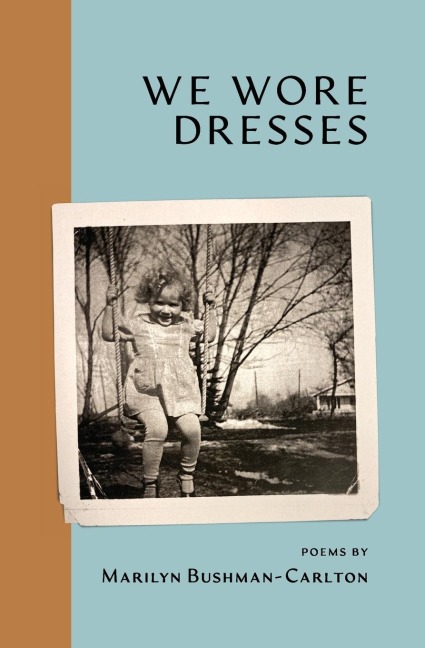
Marilyn Bushman-Carlton explores how girls her age “learned the lay of the land” and the “dead-end streets” wearing dresses. There was no “scrabbling to the rescue” or “scorching to home base” for girls. Rather, wearing “angel trumpet, fuschia, and inverted tulip” dresses, they played jacks, with “bouquets of skirt bunched in the V of their legs.” To long elegant versions, perfumed orchids were “pinned carelessly close to [their] hearts.” We Wore Dresses is the metaphorical score behind her subsequent investments in marriage and motherhood, years crescendoing with self-awareness, a resolute love for her husband and children, and a dedicated feminist voice even as grandchildren come along to “climb as high as [they] dare,” and whose turn it is to “trip into the summer grass of their enormous lives;” to make the world both “small again…and possible.”**The poems earlier in the collection show in unsparing terms how girlhood shapes womanly experience; they are indispensable for reading the later poems, more yielding and open. The book is a cabinet of wonders: even the poems that render the most painful moments of the soul’s—and body’s— progress gleam with magical naming. I am drawn to and enlivened by these generous, musical, sharp poems.– Lisa BickmoreMarilyn Bushman-Carlton's fourth poetry collection, We Wore Dresses, is the work of a mature artist completely in command of her craft. These poems explore every stage of the poet's life from girlhood to retirement and every relationship from daughter to wife to mother to grandmother with compassion, elegance, and wit. This work is not to be missed.– Holly WelkerMarilyn Bushman-Carlton offers these poems like seashells on the palm of a child at the beach for the first time, glimmering in their tender specificity. A young girl plays on the “tricky bars.”A mother is touched when her young adult son wants to watch again a movie with her that she introduced him to as a child. A group of young parents learn from a Sunday School teacher who has lost an arm. A woman in an aging body contemplates whether to give up her manicures. And here, too, are many fascinating landscapes—St. George, France, Ethiopia, an old-fashioned bathroom. The collection is a mosaic of moments—delightful, rueful, nostalgic, poignant. But the real joy is in how we get to the universal through these specifics—the tutelage of childhood, living in a body, cultural expectations and restrictions. After reading, I feel as if I’ve had a long sanity walk with a good friend, the kind you can empty yourself to and who helps you pick up each concern and turn it to the light.– Darlene YoungWe Wore Dresses is a rich collection of poems, full of Marilyn Bushman-Carlton’s wisdom. The collection demonstrates that she has lived well and loved enormously. It begins by examining what was both endearing and annoying for girls growing up in the 1960s (dresses always; physical “exercise” that kept girls weak; wanting to be thin like Audrey Hepburn, Jackie Kennedy and Twiggy; MIA girls being made responsible for boys’ sexual behavior; and hoping to find something in life to be good at). But the collection goes much farther than its title subject. The poems show continual growth and exploration for Marilyn and her family, and they embody great love and insight. The true partnership Marilyn and her husband share is demonstrated in several poems, especially “Statistics Say You’ll Die First.” Family poems abound, and there are some I will remember for the rest of my life. The poems are also superbly wrought, with lines like “lizards and toads lead lower-case lives” and “the faintest ripple a spilling whisper / a soap bubble dispersing” to describe a quickening baby in her womb.This is a collection that is meant for reading and rereading, with new rewards each time it is experienced.—Susan Elizabeth Howe

 TOP
TOP